
Tucson Water Damage Restoration Champions
Water Damage Odor Removal & Sanitizing in Tucson, AZ | Source-First Home Deodorizing
We track the smell back to the wet material causing it, remove that source, then sanitize the space so the odor does not return.
- Free inspection
- Direct insurance billing available
- IICRC-certified technicians
A smell that lingers after a leak is a signal worth taking seriously. Damp pad, swollen baseboard, a soaked cabinet floor or a wall cavity that never fully dried will keep feeding bacteria, and those bacteria give off the sour, earthy odor people describe as musty.
Our approach is to deal with the cause before the air. We probe for moisture, open what needs opening, take out material that cannot be saved, and only then apply antimicrobial treatment and air cleaning. Deodorizing a room while the source is still wet is wasted money, and we will say so.
This page covers the odor and sanitizing work that follows clean-water leaks, gray-water overflows and lingering dampness. If testing or visible growth points to a mold problem, that becomes a separate scope under our mold removal service, with its own containment rules and testing.
- Water Damage Restoration
- Water Damage Assessment and Inspection
- Insurance Claim Assistance for Water Damage Restoration
- Emergency Water Extraction Services
- Structural Drying Services
- Mold Removal
- Sewage Backup Cleanup
- Burst Pipe Water Damage Cleanup
- Slab Leak Water Damage Repair
- Water Heater Leak Cleanup
- Swamp Cooler & AC Leak Water Damage
- Monsoon Storm & Flood Damage Restoration
- Roof Leak & Ceiling Water Damage Repair
- Wet Carpet & Pad Drying
- Hardwood Floor Water Damage & Drying
- Drywall Water Damage Repair
- Contents Pack-Out & Restoration
- Commercial Water Damage Restoration
- Water Damage Reconstruction & Rebuild
Our Water Damage Odor Removal & Sanitizing Services
Odor Source Tracing and Removal
We start with the nose and then confirm with instruments. A pin moisture meter, a non-invasive scanner and a thermal camera help us find the damp section of subfloor, the wet bottom plate behind a vanity, or the pad that soaked up a dishwasher overflow weeks ago.
Once located, porous material that has absorbed contaminated water usually comes out: carpet pad, particleboard toe kicks, insulation and the lower strip of saturated drywall. Removing a few square feet of the right material often does more for the smell than any amount of fogging.
Antimicrobial Cleaning and Sanitizing
After the source is gone, exposed framing, slab and cavity surfaces are cleaned and treated with a registered antimicrobial, left on for the contact time its label requires. That step reduces the bacterial load that produces odor and gives the drying phase a cleaner, safer starting point.
Hard surfaces such as tile, sealed concrete and vanity interiors are wiped and sanitized as well. For gray-water events, such as a washing machine drain backing up, we treat a wider margin around the visible wet line because contamination travels farther than the stain shows.
HEPA Air Scrubbing
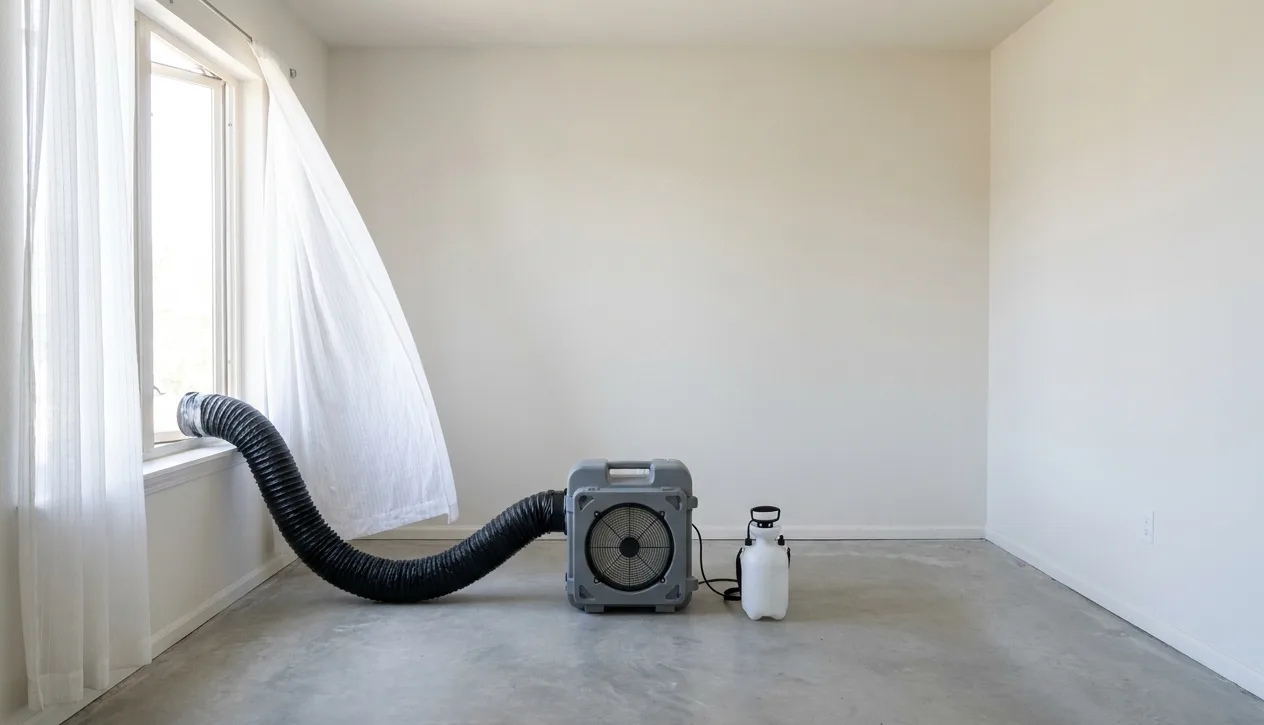
Odor travels on fine particles and in the air itself, so surfaces are only half the job. We set up HEPA air scrubbers, often with an activated carbon stage, sized to the room volume so the air is filtered several times an hour while demolition, cleaning and drying are underway.
Scrubbers can also be ducted to create slight negative pressure in the work area, which keeps disturbed dust and smell from drifting into bedrooms or the kitchen. They keep running through the whole drying period, so the air is clear and neutral when the equipment finally leaves.
Hydroxyl and Ozone Deodorization
For odor that has soaked into framing, closets or soft goods, we may use a hydroxyl generator. Hydroxyl units produce reactive radicals that break down odor molecules, and in most cases people and pets can remain in the home while one runs, which matters when moving out is not practical.
Ozone is stronger but has safety limits. It irritates lungs, so the space must be empty of people, pets and plants during treatment and aired out afterward, and it can degrade rubber and some fabrics. We use it only in vacant, sealed areas and explain the trade-off first.
Our Water Damage Odor Removal Process
Inspect and Measure
We walk every affected room, ask when and where the water first came in, and take moisture readings in floors, walls, cabinets and trim. Thermal imaging helps us spot cooler, damp zones behind finished surfaces. Nothing is cut until every likely source is mapped out.
Remove the Source
Saturated pad, insulation, swollen trim and wet drywall that cannot be dried in place are bagged and hauled out. Any remaining wet structure is dried with air movers and dehumidifiers until readings match dry reference points elsewhere in the house, because damp wood will keep producing odor.
Clean, Treat and Scrub the Air
Exposed surfaces are HEPA vacuumed, cleaned and treated with antimicrobial. Air scrubbers run the entire time. Where odor has migrated into framing or a closet, we add hydroxyl treatment or, in a vacant sealed space, a controlled ozone cycle followed by full ventilation before anyone returns.
Verify and Hand Off
Before we wrap up, we recheck moisture, do a smell test with you in each room, and confirm the space is ready for repairs. If drywall or flooring needs replacing, we share our notes and photos so the repair crew starts from a clean, dry and documented base.
Why Choose Us for Water Damage Odor Removal
We Fix the Cause, Not the Symptom
Every odor job begins with moisture readings, not a fogger. If the smell traces back to an active plumbing drip or a slab that is still wet, we document it and tell you what has to happen first. That keeps you from paying for a treatment that would fade.
Clear Notes for Your Adjuster
We photograph the wet material before removal, record meter readings with locations, and list the products and equipment used along with their run times. When the smell ties to a covered loss, that record shows your insurer exactly what was done and why it was needed.
Plain Talk About Safety
Antimicrobials, ozone and hydroxyl each have their own handling rules. Before we start, we explain which rooms you can use, whether pets need to stay elsewhere, and how long ventilation will take. Our IICRC certified technicians follow product labels exactly rather than overapplying to chase faster results.
Why Odors Hide in Tucson Homes
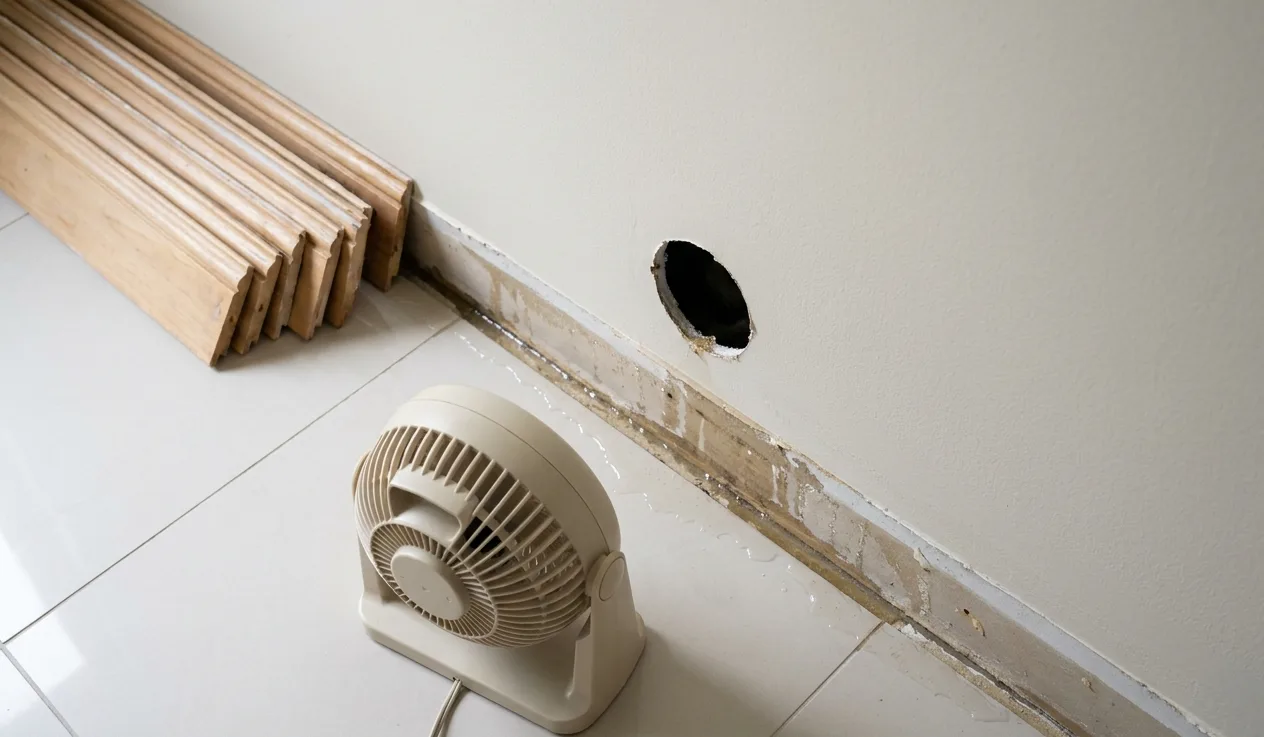
Desert air works against the nose. With humidity low for much of the year, a carpet surface or painted wall can feel dry within a day while the pad underneath or the cavity behind stays damp. The smell then shows up weeks later, once bacteria have had time to grow.
A leaking cooler pan or a clogged drain line can drip into an attic or down a wall for weeks, and the cooler then pushes that stale air through the house. Tiled slab-on-grade floors hide moisture too, so we check grout and baseboards along the slab edge.
What Water Damage Odor Removal Costs in Tucson
Odor and sanitizing work is priced by how much material has to come out, the square footage treated and how long air scrubbers or hydroxyl units need to run. Most jobs fall between $500 and $3,000. The figures below are ranges, not quotes; your number comes after we inspect.
Price climbs when odor has spread into several rooms, when gray water was involved, or when ozone treatment requires the home to be vacated and sealed. When the smell follows a covered water loss, deodorizing is often part of the claim, and our documentation goes to your adjuster. The first visit and moisture check cost nothing.
| Scope | Typical range |
|---|---|
| Odor source inspection and moisture check | Free |
| Odor removal and sanitizing | Most jobs $500–$3,000 |
| Wet carpet and pad removal or drying | Starting at $500; most jobs $500–$2,500 |
| Structural drying when the source is still wet | Most jobs $1,500–$6,000 |
Water Damage Odor Removal FAQs
Why does my house still smell musty after the leak was fixed?
Fixing the pipe stops new water, but whatever got wet before the repair can stay damp for weeks, especially pad, insulation and the bottom of drywall. Bacteria growing in that material make the smell. Until it is dried or removed, airing out the room will not stop the odor for long.
Is ozone safe to use in my home?
Ozone works, but it is a lung irritant. Nobody, including pets, should be inside during treatment, plants should be removed, and the area must be ventilated afterward. It can also harden rubber seals over time. For occupied homes we usually prefer hydroxyl units, which can run safely while people are present.
How much does water damage odor removal cost?
Most odor removal and sanitizing jobs fall between $500 and $3,000. One room with a little wet pad usually sits at the low end. Multiple rooms, gray water, or treatment that requires ozone and vacating the home push the total higher. You get a written estimate after our free inspection visit.
Can you remove the smell without tearing anything out?
Sometimes. If the material only got clean water and can be dried quickly, cleaning, antimicrobial treatment and air scrubbing may be enough. If pad, insulation or particleboard absorbed dirty water or stayed wet for days, removal is usually the only lasting fix. Our readings tell us which situation you are in.
Is odor removal the same as mold removal?
No. Odor work targets bacteria, wet debris and smells left after water damage. Mold removal follows a separate standard, IICRC S520, with containment and clearance steps. If we see visible growth or suspect mold during an odor job, we stop, explain what we found and quote that work as a separate scope.
Find Us for Water Damage Odor Removal & Sanitizing in Tucson
Get a Free Water Damage Odor Removal & Sanitizing Inspection
Call any time, or send the form and we'll call you back.